Quick Answer
Medicaid NEMT brokers score providers on complaint rates, response times, after-hours availability, and grievance resolution, and those scores drive trip assignments and contract renewals. Every unanswered call risks becoming a complaint on your scorecard. Round-the-clock live support closes that gap, and outsourcing it to a HIPAA-trained team costs a fraction of staffing three shifts in-house.
In the Medicaid NEMT world, customer support quality is not a soft metric. It is contract security. Brokers sit between you and the payer, and they measure everything: how fast calls get answered, how complaints get resolved, and whether anyone picks up at 11 p.m. when a discharge goes sideways. Providers who treat support as an office-hours function eventually discover the cost, one scorecard cycle at a time.
How Do Brokers Evaluate Your Customer Support?
Major brokers track provider performance through scorecards, and the support-related lines typically include:
- Complaint rates per trip volume: every rider grievance that reaches the broker counts against you
- Response times: how quickly riders and broker staff reach a live person
- After-hours availability: what happens to calls outside business hours
- Grievance resolution timelines: how fast complaints get investigated and closed
- Rider satisfaction feedback: surveys and callbacks brokers run on your passengers
Notice what these have in common: none of them care how good your intentions were. They measure whether a phone got answered and a problem got fixed. That is the standard your support operation is graded on, whether you staff for it or not, and it is graded continuously, on every trip, every day of the contract.
Why Does 24/7 Coverage Matter So Much?
Because medical transportation does not keep office hours. Hospital discharges land at midnight. Dialysis riders confirm pickups before dawn. Will-calls, cancellations, and schedule changes scatter across every hour of the week. Call volume peaks in the morning, but the calls that generate complaints cluster in the hours nobody staffs: the missed evening will-call, the unanswered weekend line, the holiday voicemail.
A provider whose phones roll to voicemail at 6 p.m. is invisible for the hours when riders are most stressed and brokers are most attentive. Providers with genuine 24/7 live answer simply accumulate fewer complaints, because problems get caught while they are still phone calls instead of grievances.
What Does Poor Support Actually Cost?
The damage follows a predictable chain, and each link is worth seeing clearly:
- 1Missed calls become complaints. A rider who cannot reach you calls the broker instead, and now the interaction is on the record, framed by the rider, with your side of the story absent.
- 2Complaints accumulate on your scorecard. Individually forgivable, collectively they define your ranking against other providers in your region.
- 3Poor scores shrink trip assignments. Brokers steer volume toward providers who make their lives easier. Fewer trips, same fixed costs.
- 4Eventually, non-renewal. The contract that anchors your fleet quietly goes to a competitor whose phones get answered.
The brutal part is that the spiral is silent. No one calls to tell you assignments are drifting away. Volume just softens quarter after quarter while the scorecard does the talking.
The good news is that the loop runs just as reliably in reverse. Providers who answer around the clock, resolve problems at first contact, and keep grievance timelines tight become the providers brokers lean on: the first call when another provider drops a route, the safe pair of hands for the fragile standing orders. Support quality is one of the few scorecard inputs entirely within your control: you cannot dictate traffic or hospital discharge times, but you can decide whether the phone gets answered.
How many calls are you missing after 6 p.m.?Free operations audit: we will map your coverage gaps within 1 business day.
Get My Free AuditWhat Should a 24/7 Support Operation Actually Handle?
"Answering the phone" undersells the job. A support operation that genuinely protects a Medicaid contract covers the full span of after-hours reality:
- Will-call activation: the rider whose appointment ran long and now needs the return leg dispatched
- Discharge coordination: hospitals releasing patients at night who need a ride arranged before a bed is needed
- Driver support: no-shows at the door, wrong addresses, vehicle trouble, and riders who need extra help
- Broker communication: portal updates and status responses inside the windows brokers expect
- Complaint intake: capturing a grievance calmly at first contact, before it escalates to the broker
- Schedule changes and cancellations: processed immediately so tomorrow's board starts clean
Each of those, handled live, is a routine call. Each of them, sent to voicemail, is a potential scorecard entry. That asymmetry is the entire business case for around-the-clock coverage.
How Do You Build 24/7 Support Without Tripling Payroll?
Staffing live support around the clock in-house means three shifts, weekend rotations, PTO coverage, and management for all of it. That is a heavy commitment most small and mid-size fleets cannot justify, which is exactly why so many quietly run uncovered nights instead.
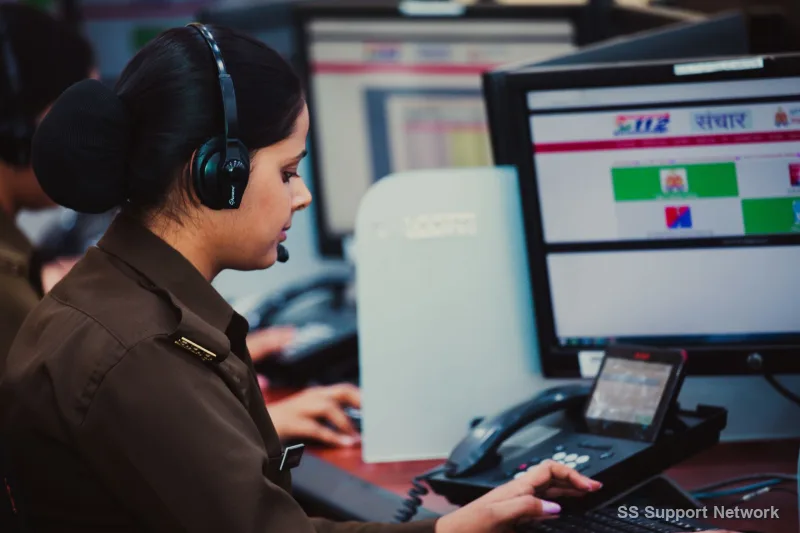
Outsourcing solves the economics. A specialized healthcare call center answers in your company's name 24/7/365 with HIPAA-trained agents, at a fraction of the fully-loaded cost of staffing it yourself. Savings typically run 35-70% versus in-house (SS Support Network operations data). The strongest results come when support and dispatch run as one team, so the agent taking a rider's call can see the trip board and fix the problem in the same conversation instead of relaying messages between vendors.
What to verify before signing: genuine staffed coverage (not an answering service that pages someone), NEMT experience, work inside your existing systems, and complaint-handling procedures that match your brokers' timelines. Pricing for this scope is laid out on our pricing page.
A practical way to start is after-hours only: keep your office team on daytime calls and hand evenings, nights, weekends, and holidays to the partner. You close the exact hours where complaints breed, at the smallest possible scope, and you get weeks of real calls to judge quality before deciding whether to consolidate the rest. Most fleets that run this experiment expand it, because the difference shows up on the scorecard within a cycle or two.
What Does This Look Like in Practice?
Our flagship NEMT client hands us every inbound call (riders, drivers, facilities, brokers) around the clock, alongside dispatch and billing. Over two-plus years, clean portal management and reliable answer rates helped brokers assign more trips as confidence built, supporting the client's expansion from one state to a multi-state operation. The complete account is in the case study, and the pattern is repeatable: consistent support is what brokers and riders actually reward.
The Bottom Line
24/7 customer support is not a luxury line item for NEMT providers. It is contract retention. Broker scorecards convert every unanswered call into quiet, compounding damage, and they convert every answered one into trust. If staffing three shifts is out of reach, outsource the coverage; what you cannot afford is the gap.
Frequently asked questions
Because broker scorecards grade you on complaint rates, response times, and after-hours availability, and those scores drive trip assignments and renewals. Calls that roll to voicemail at night become rider complaints that reach the broker. Genuine round-the-clock live answer keeps problems as phone calls instead of scorecard entries.
Major brokers track provider performance on scorecards covering complaint rates per trip volume, how fast riders and broker staff reach a live person, after-hours availability, grievance resolution timelines, and rider satisfaction feedback. None of these measure intentions; they measure whether a phone got answered and a problem got fixed.
Usually yes. Staffing three in-house shifts with weekend rotations, PTO coverage, and management is a heavy fixed cost most small and mid-size fleets cannot justify. Outsourcing to a HIPAA-trained team typically saves 35-70% versus the fully-loaded cost of in-house staff (SS Support Network operations data), while adding genuine overnight coverage.
Yes, and it is a common way to start. Keep your office team on daytime calls and hand evenings, nights, weekends, and holidays to the partner. You close the exact hours where complaints breed, at the smallest scope, and get weeks of real calls to judge quality before expanding.
A support operation that protects a Medicaid contract covers will-call activation, night discharge coordination, driver support for no-shows and vehicle trouble, broker portal updates inside expected windows, calm complaint intake at first contact, and immediate processing of schedule changes and cancellations. Handled live, each is a routine call rather than a scorecard entry.